
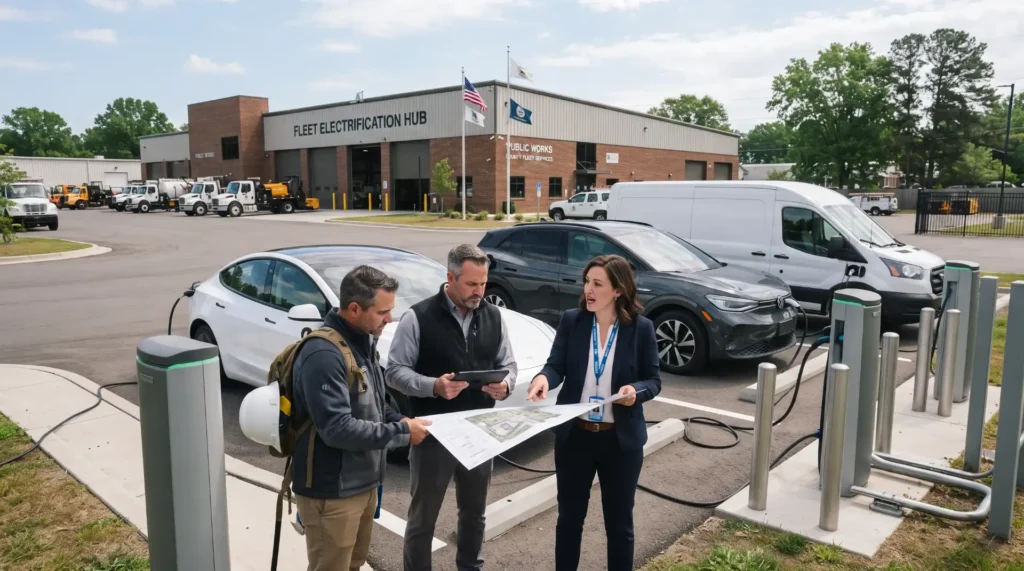
Electric vehicles are becoming an increasingly important consideration for public-sector fleet managers across the United States. Cities, counties, school districts, universities, transit organizations, public utilities, state agencies, and other government institutions are evaluating how electric vehicles could fit into their transportation operations. However, acquiring electric vehicles is fundamentally different from purchasing conventional fleet vehicles because the vehicle itself is only one component of the overall investment.
For public procurement professionals, the transition to electric transportation creates a much broader purchasing challenge. An agency may need to acquire vehicles, charging equipment, electrical upgrades, construction services, software, networking, maintenance, energy-management systems, warranties, and long-term technical support. Each component can involve different vendors, contract terms, technical requirements, funding conditions, and operational responsibilities.
This makes public procurement for electric vehicles and charging infrastructure an important emerging area for government purchasing professionals.
The procurement process needs to consider the complete lifecycle of the project rather than focusing exclusively on the initial vehicle purchase price. A government agency that buys electric vehicles without adequately planning for charging capacity, facility requirements, maintenance, software, and future expansion may encounter unexpected costs or operational limitations.
The U.S. Department of Energy’s Alternative Fuels Data Center provides guidance on charging infrastructure development, including site considerations, electrical requirements, utility coordination, equipment selection, and installation. These considerations demonstrate why EV procurement should be approached as an integrated fleet and infrastructure project rather than a simple equipment purchase.
For procurement professionals, the objective is not necessarily to select the newest vehicle or the fastest charger available. The objective is to develop a fair, competitive, legally appropriate acquisition process that meets the agency’s operational requirements and protects public resources over the useful life of the investment.
Why EV Procurement Requires a Different Approach
Traditional fleet procurement often focuses on vehicle acquisition price, specifications, fuel economy, reliability, maintenance, warranty coverage, and expected service life. Electric vehicles require many of the same considerations, but they add an important infrastructure component.
A gasoline-powered fleet can generally rely on an established refueling network. Government agencies may already have fuel tanks, fueling contracts, fleet cards, or nearby commercial stations. Electric vehicles, by comparison, may require charging equipment at government facilities or other strategically selected locations.
That infrastructure can include charging stations, electrical panels, transformers, conduit, wiring, networking equipment, software platforms, communications systems, signage, pavement work, security features, and ongoing maintenance.
The agency may also need to coordinate with an electric utility before installation begins.
Consequently, the procurement team may find itself working with fleet managers, facilities personnel, engineers, information technology professionals, finance departments, utility representatives, construction contractors, vehicle manufacturers, charging-equipment suppliers, and software providers.
The purchasing process must bring these different requirements together.
This is one reason EV procurement is a useful example of the changing role of modern public purchasing. Procurement professionals increasingly manage acquisitions that combine physical products, construction, technology, data, services, and long-term vendor relationships.
MAPPI has previously examined this broader transformation in its discussion of technology and modern public purchasing. The article The Role of Technology in Modernizing Public Purchasing: MAPPI’s Vision provides useful background on how digital tools, data analytics, electronic systems, and cybersecurity are changing government procurement.
Begin With Fleet Operations
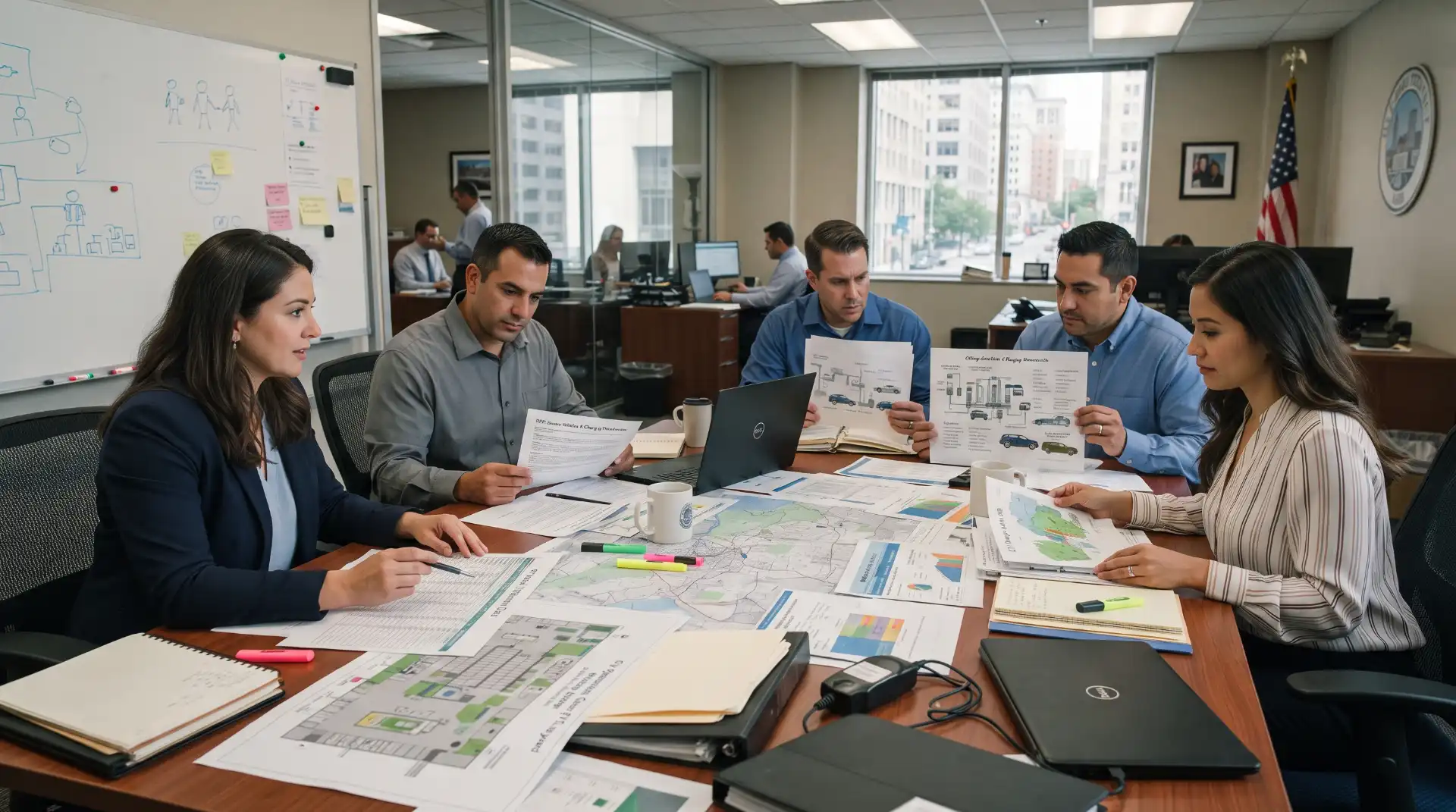
One of the most important principles in EV procurement is to begin with operational requirements instead of beginning with a particular vehicle or charging station.
An agency should first understand how its fleet operates.
How many miles does each vehicle typically travel during a day? Where are vehicles parked overnight? How long do they remain at the facility? Are vehicles used during multiple shifts? Do some vehicles travel outside the agency’s normal service area? Are vehicles required to remain available for emergencies? Which vehicles return to a central facility and which ones remain in the field?
The answers can dramatically change infrastructure requirements.
A municipal administrative fleet with vehicles parked overnight for eight to twelve hours may have relatively straightforward charging needs. A public works department operating vehicles for extended shifts could require a different charging strategy. Emergency-response fleets may need additional planning because vehicles cannot simply remain connected to chargers for long periods.
Procurement decisions should reflect actual use patterns.
This operational assessment also helps prevent agencies from purchasing more infrastructure than they need. Faster charging equipment can be more expensive and may require additional electrical capacity. If vehicles already spend many hours parked at a facility, extremely rapid charging may not provide enough additional operational value to justify the added expense.
The reverse is also true. An agency with vehicles operating continuously may discover that slower charging equipment creates unacceptable downtime.
The appropriate solution is therefore dependent on the fleet.
Conduct a Detailed Charging Assessment
After analyzing fleet operations, agencies can determine how much charging infrastructure they actually require.
The U.S. Department of Energy recommends evaluating factors such as vehicle duty cycles, charging locations, power requirements, charging equipment, and utility considerations when developing EV infrastructure.
A charging assessment should consider both present needs and anticipated fleet growth.
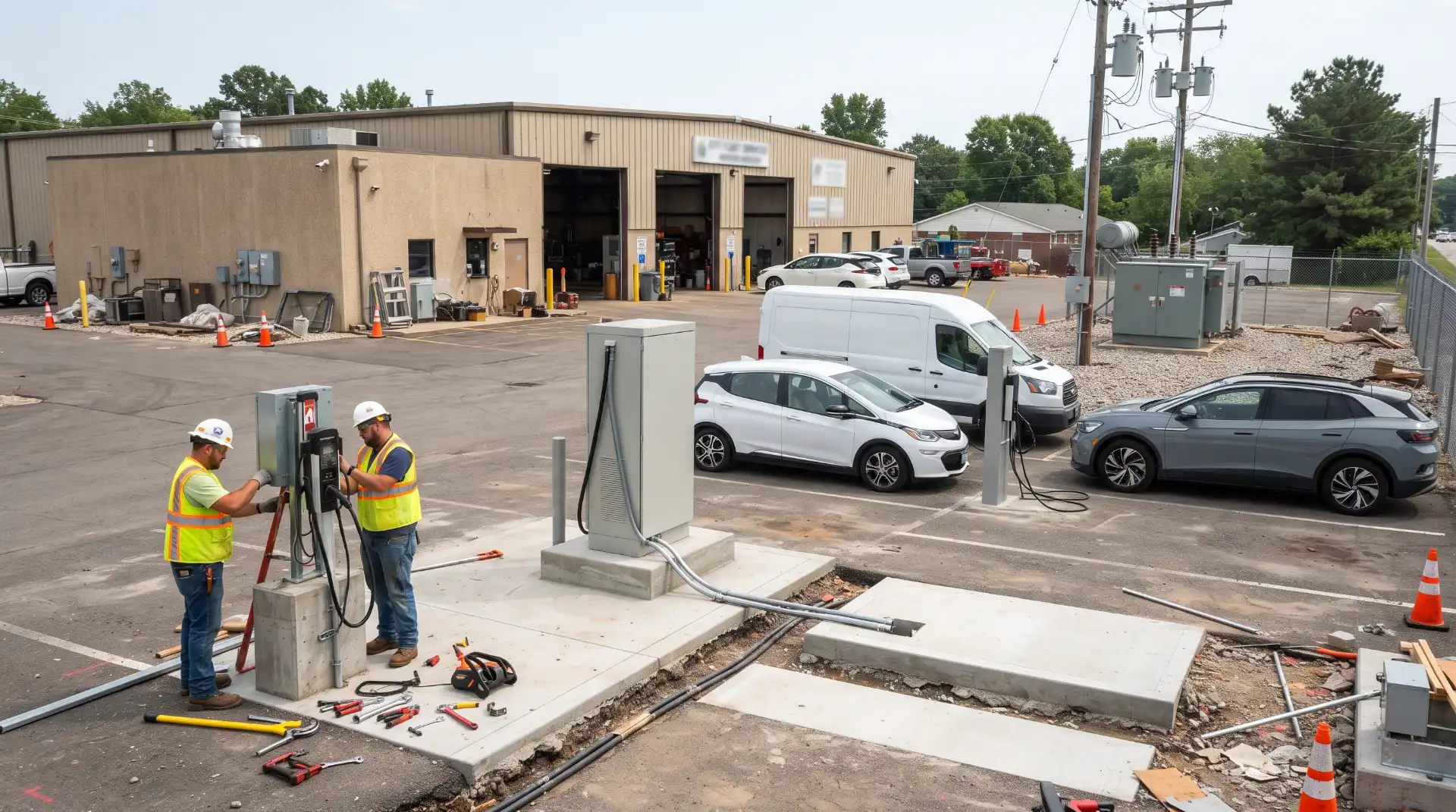
Government agencies should examine the physical characteristics of each potential charging site. Parking spaces may need to be redesigned or reassigned. Electrical equipment may need upgrades. Conduit may need to be installed underground. Additional transformers or electrical distribution equipment may be required.
The location of the charging equipment is also important.
Chargers should be positioned so that government vehicles can access them without creating traffic conflicts or unnecessary operational delays. Maintenance personnel need adequate access to the equipment. Publicly accessible facilities may also need to consider pedestrian circulation, accessibility, lighting, security, and signage.
These issues should be resolved during planning rather than after the charging equipment has been purchased.
Understanding Different Charging Levels
Public procurement documents should clearly identify the charging performance required by the agency.
Level 1 charging generally provides the slowest charging capability and may be suitable for vehicles that remain parked for long periods. It may have applications in certain low-mileage fleet situations, but agencies need to evaluate whether the charging rate matches operational requirements.
Level 2 charging provides greater charging capability and is commonly used for workplace, commercial, municipal, and fleet applications. It can be appropriate for vehicles that return to a government facility and remain parked for several hours.
DC fast charging can provide substantially faster charging and may be useful for high-utilization fleets. However, faster charging can require more electrical capacity and potentially greater infrastructure investment.
Procurement teams should avoid automatically specifying the highest charging capacity available.
A charger that is significantly faster than operational requirements may increase costs without delivering meaningful benefits. On the other hand, infrastructure that cannot replenish vehicle energy during available charging windows could create operational problems.
The correct procurement question is therefore not simply, “What is the fastest charger available?”
It is, “What charging performance does this fleet actually require?”
Total Cost of Ownership Should Be Part of the Analysis
Initial acquisition price is an important consideration in public purchasing, but EV procurement can make lifecycle costs especially important.
The total cost of an electric fleet project can include vehicle acquisition, charging equipment, electrical work, construction, software, networking, installation, maintenance, energy costs, replacement components, warranties, training, and future upgrades.
Some costs occur before the vehicles are delivered. Others continue throughout the life of the infrastructure.
For example, a charging network may require recurring software or connectivity fees. A charger may require maintenance or replacement parts. Electrical infrastructure may need future expansion as the fleet grows.
Procurement professionals should therefore examine the entire cost structure permitted under their procurement rules.
A lower initial bid may not necessarily represent the lowest overall cost if it comes with significantly higher maintenance requirements, restrictive software arrangements, limited warranties, or expensive service agreements.
The procurement documents should make clear how pricing will be evaluated and whether lifecycle costs or other permitted factors will be considered.
Charging Infrastructure Is Also a Construction Project
One common mistake in EV procurement is treating charging infrastructure as if it were simply another piece of equipment.
In reality, many projects involve substantial construction and electrical work.
Depending on the site, installation can involve trenching, conduit, concrete work, electrical panels, transformers, wiring, utility coordination, parking modifications, protective equipment, signage, and inspections.
This creates an important procurement question: who will be responsible for the installation?
An agency could purchase charging equipment separately and contract with an electrical contractor for installation. It could procure an integrated design-and-installation project. It could use a contractor responsible for engineering, procurement, and construction. It could also use another model permitted by its applicable procurement rules.
Each approach has advantages and disadvantages.
A separate equipment purchase may provide greater control over equipment selection but can create coordination responsibilities for the agency.
An integrated contract may simplify project management but requires carefully written specifications to prevent uncertainty over responsibilities.
The appropriate model should be determined during procurement planning.
Coordinate With the Utility Before Solicitation
Utility coordination should begin as early as possible.
The electrical service available at a government facility may not be sufficient for the planned charging equipment. If additional capacity is required, the utility may need to conduct studies, upgrade infrastructure, install new equipment, or coordinate construction.
Those processes can affect the project schedule.
The Department of Energy’s Alternative Fuels Data Center recommends early utility engagement because utilities can help agencies understand power availability, electrical capacity, service requirements, and potential charging strategies.
Procurement professionals should therefore avoid creating a solicitation schedule that assumes the electrical infrastructure is automatically ready.
A charger may arrive at a government facility on time, but the project can still be delayed if the electrical service needed to operate it has not been completed.
Utility requirements should be considered before the procurement schedule is finalized.
Plan for Future Fleet Expansion
A public agency may begin with a relatively small electric fleet.
That does not mean the charging infrastructure should be designed without considering future expansion.
Suppose a city initially purchases ten electric vehicles. Several years later, it may want to add another twenty or thirty. If the original site design cannot accommodate additional charging equipment, the agency may have to undertake expensive construction again.
Planning for expansion does not necessarily mean purchasing all future chargers immediately.
Instead, agencies can consider future electrical capacity, conduit pathways, parking layouts, networking requirements, and equipment placement during the initial project.
Installing some infrastructure that can support future chargers may be more efficient than rebuilding the site later.
This is particularly important for government agencies that expect fleet electrification to occur over several procurement cycles.

Procurement Specifications Should Be Performance-Based
A strong EV solicitation should describe the agency’s actual requirements rather than unnecessarily limiting competition to a particular product.
Performance-based specifications can address charging capacity, operating conditions, electrical requirements, communications capabilities, software functionality, data access, cybersecurity, maintenance, warranty coverage, interoperability, and other measurable requirements.
This allows procurement teams to communicate what the government needs while potentially giving qualified suppliers room to propose different approaches.
Technical personnel should work closely with procurement staff when specifications are developed.
Fleet managers understand vehicle operations. Facilities professionals understand site requirements. IT professionals understand network and cybersecurity concerns. Procurement professionals understand competition, solicitation procedures, evaluation requirements, and contract administration.
Bringing these perspectives together can produce stronger specifications.
Avoid Unnecessary Vendor Lock-In
Interoperability deserves special attention in EV infrastructure procurement.
Charging equipment may remain in service for many years. During that time, the agency could change vehicles, software providers, network providers, contractors, or fleet-management systems.
If the original procurement creates excessive dependence on a single vendor, changing providers later may be difficult or expensive.
Agencies can therefore consider whether charging equipment supports appropriate industry standards and whether operational data can be accessed and transferred.
The goal is not to eliminate every proprietary technology. Some proprietary features may provide legitimate operational benefits.
Instead, procurement teams should understand the long-term consequences of vendor dependence before entering into a multiyear arrangement.
This can include asking who owns the charging data, whether the agency can export its information, what happens if the software provider ends service, and whether the charging equipment can continue operating if a network service becomes unavailable.
Cybersecurity Must Be Considered
Modern charging stations can contain communications and software capabilities.
Network-connected charging equipment may communicate with cloud platforms, energy-management systems, fleet software, agency networks, or payment systems.
This creates cybersecurity considerations.
Government agencies should involve appropriate IT and cybersecurity personnel when connected charging infrastructure is being procured.
Potential procurement requirements can address authentication, software updates, vulnerability management, data protection, incident notification, remote access, network segmentation, logging, and vendor security practices, depending on the agency’s requirements and applicable rules.
GSA’s guidance for federally owned EV supply equipment addresses information-technology security considerations for network-connected equipment.
State and local governments may operate under different requirements, so procurement professionals should determine which standards and policies apply to their particular agency.
Cybersecurity should not be added after the equipment has already been selected.
Federal Funding Can Create Additional Procurement Requirements
Federal funding can introduce additional requirements into EV infrastructure projects.
This is particularly important for charging projects associated with federally funded transportation programs.
Buy America requirements, domestic-content provisions, applicable waivers, grant conditions, reporting requirements, and other federal rules can affect procurement specifications and contract administration.
The Federal Highway Administration has published guidance concerning Buy America requirements for EV chargers used in applicable federally funded highway projects.
Requirements can change over time, so agencies should verify current federal guidance before issuing a solicitation.
This is an important procurement principle for any federally funded project: agencies should identify applicable requirements based on the actual funding source and project rather than assuming that every EV project is governed by the same rules.
Vendor Evaluation Should Go Beyond the Equipment
When agencies evaluate proposals, the charging equipment itself is only one part of the supplier’s capability.
The agency may also need to assess the vendor’s experience, installation capability, technical support, warranty program, maintenance resources, software platform, cybersecurity practices, financial capacity, project management capabilities, and ability to meet delivery schedules.
The exact evaluation criteria must comply with the agency’s procurement laws and solicitation requirements.
For a complex EV project, however, technical and operational capability can be particularly important.
A supplier that provides excellent hardware but cannot provide adequate support may create problems after installation.
Similarly, an installer that understands electrical construction but has limited experience with networked charging equipment may not be appropriate for a project requiring advanced software integration.
The solicitation should clearly establish what qualifications and evaluation factors matter.
Contract Management After Installation
Winning the contract and installing the chargers is not the end of the procurement lifecycle.
Government agencies need to manage performance after award.
This can include monitoring delivery schedules, installation quality, charger uptime, software performance, maintenance response times, warranty claims, energy-management functions, and other requirements established by the contract.
If maintenance services are included, the contract should establish measurable expectations.
For example, an agency may define response times for equipment failures, procedures for documenting repairs, escalation processes for recurring problems, and reporting requirements.
Post-award monitoring can help procurement officials identify recurring performance issues before they become major operational problems.
MAPPI’s existing Navigating Public Procurement: A Guide for Missouri Professionals discusses vendor selection, contract management, and post-award monitoring. This provides a useful internal resource for readers interested in the broader procurement lifecycle.
Maintenance Planning Should Begin Before Purchase
Charging infrastructure requires long-term maintenance just like other government assets.
Maintenance requirements can include inspections, electrical service, software updates, network support, replacement components, equipment repairs, and warranty administration.
Agencies should determine whether maintenance will be handled internally or by a contractor.
If the agency expects the supplier to provide long-term support, the contract should establish the duration and scope of that support.
Procurement officials should also examine what happens after the warranty expires.
A charger may remain useful for many years after the original warranty period. If replacement parts or software support become unavailable, the agency could face premature equipment replacement.
Long-term support should therefore be considered during the initial procurement rather than after the equipment is already installed.
Data and Reporting Are Increasingly Important
Networked charging equipment can produce substantial operational data.
Depending on the system, an agency may be able to monitor charger utilization, charging sessions, energy consumption, equipment availability, maintenance issues, and other performance information.
This information can help fleet managers determine whether the infrastructure is being used effectively.
It can also help procurement professionals evaluate vendor performance.
For example, if the contract establishes a particular availability requirement, the agency may be able to use system data to monitor whether the contractor is meeting that requirement.
Data can also support future procurement planning by showing how frequently chargers are used and where additional infrastructure may be needed.
MAPPI’s existing article on The Role of Technology in Modernizing Public Purchasing: MAPPI’s Vision discusses the growing role of data analytics and digital systems in government procurement. That discussion is particularly relevant to EV infrastructure because charging systems combine physical assets with technology and data.
Supply Chain Risk Should Be Considered
EV procurement involves multiple supply chains.
Vehicle manufacturing, batteries, charging equipment, electrical components, software, networking equipment, construction materials, replacement parts, and maintenance services may involve different suppliers.
A delay in any one of these areas can affect the overall project.
Procurement professionals should therefore consider delivery schedules, supplier capacity, availability of replacement parts, warranty support, and potential dependencies.
This does not mean agencies need to predict every possible supply disruption.
Instead, they should identify the risks that could materially affect the project.
MAPPI’s recent article Supply Chain Risk Management for Public Agencies: Lessons for Government Buyers in 2026 provides a useful related resource for understanding how government buyers can assess supplier dependencies, delivery risks, cybersecurity concerns, and continuity planning.
Cooperative Purchasing May Be an Option
Some public agencies may not need to conduct a completely independent EV procurement.
Depending on applicable laws and purchasing authority, agencies may be able to use cooperative purchasing contracts, state contracts, federal schedules, or other established procurement vehicles.
Cooperative purchasing can potentially reduce administrative work and provide access to vendors that have already gone through a competitive procurement process.
However, agencies should verify that the specific cooperative contract is legally available to them and that its terms meet their operational requirements.
An existing contract may provide a useful starting point, but it should not automatically be assumed to be appropriate simply because it involves electric vehicles or charging equipment.
Procurement professionals should review scope, pricing, contract terms, warranties, installation requirements, service levels, and applicable funding conditions.
Accessibility and Public Use Should Be Addressed
Some government charging stations will be located in facilities used by the public.
In these cases, accessibility should be incorporated into site design and procurement planning.
Parking spaces, pedestrian routes, equipment placement, signage, physical access, lighting, and other design considerations can affect whether users can safely and effectively access charging equipment.
Federal facilities may have specific accessibility obligations, while state and local agencies may be subject to other federal, state, and local requirements.
Procurement teams should involve facilities and accessibility specialists early enough that the requirements can be incorporated into the project design.
Waiting until construction is nearly complete can make accessibility changes more expensive and disruptive.
Training and Staff Readiness Matter
An EV infrastructure project can introduce new responsibilities for government employees.
Fleet managers may need to learn new vehicle-management procedures. Facilities staff may need training related to charging equipment. IT staff may need to understand network requirements. Drivers may need instruction on charging procedures.
Procurement documents can address training requirements where appropriate.
Training can cover basic equipment operation, emergency procedures, troubleshooting, software administration, reporting, and maintenance escalation.
The agency should identify who will be responsible for each area before the project is completed.
A technically successful installation can still create operational difficulties if employees do not know how to use or manage the system.
Establish Clear Responsibilities
Complex EV projects can involve many parties.
The vehicle supplier may be responsible for vehicles and vehicle warranties. The charging-equipment supplier may be responsible for hardware. An electrical contractor may handle installation. A software provider may operate the charging network. The utility may provide electrical service. The government agency may manage the overall project.
If responsibilities are not clearly defined, problems can occur when something goes wrong.
Suppose a charger stops working. Is the problem caused by the charger, electrical service, network connectivity, software, or vehicle?
The contract should provide a process for determining responsibility and escalating unresolved issues.
Clear responsibilities can reduce disputes and help agencies restore service more quickly.
Build Future Flexibility Into the Contract
Technology changes quickly.
An EV charging system purchased today may remain in service for many years, while software platforms, communication standards, vehicle models, and fleet-management systems continue to evolve.
Procurement documents should therefore avoid unnecessary restrictions that could prevent the agency from adapting later.
This can include considering data portability, software updates, equipment compatibility, maintenance support, replacement parts, and future expansion.
Contracts should also define what happens if a vendor discontinues a product or service.
For multiyear agreements, agencies may want to consider transition provisions that help protect continuity if the relationship ends.
The precise contract language should be developed with the agency’s legal and procurement requirements in mind.
Common EV Procurement Mistakes
Several procurement mistakes can make an EV infrastructure project more difficult than necessary.
One is purchasing vehicles before determining where and how they will be charged. Another is selecting charging equipment based solely on maximum charging speed rather than actual fleet requirements.
Agencies can also underestimate electrical construction costs or fail to coordinate with utilities early enough.
Another common problem is focusing heavily on the initial equipment price while overlooking software, maintenance, networking, warranties, and long-term support.
Agencies can also create unnecessary vendor lock-in by failing to consider interoperability and data access.
Finally, procurement teams may treat installation as the end of the project instead of planning for years of maintenance, monitoring, contract administration, and fleet expansion.
These challenges can often be reduced through stronger procurement planning.
A Practical EV Procurement Process for U.S. Agencies
A public agency can approach EV procurement as a series of connected stages.
The first stage is fleet analysis. Procurement professionals should work with fleet managers to understand vehicle use, mileage, routes, duty cycles, parking locations, and charging windows.
The second stage is infrastructure planning. Facilities and engineering personnel should evaluate electrical capacity, utility requirements, construction conditions, parking, accessibility, security, and expansion opportunities.
The third stage is market research. Agencies should identify available vehicle classes, charging technologies, software platforms, service models, suppliers, and maintenance options.
The fourth stage is procurement strategy. The agency should determine whether it will separately procure vehicles and infrastructure, use an integrated contract, participate in a cooperative purchasing arrangement, or use another authorized method.
The fifth stage is solicitation development. Requirements should be clear, measurable, competitive, and consistent with applicable law.
The sixth stage is evaluation and award. Proposals should be evaluated using the criteria established in the solicitation, with decisions documented appropriately.
The final stage is contract administration. The agency should monitor installation, performance, maintenance, warranties, costs, data, and service levels throughout the contract.
This lifecycle approach helps ensure that procurement remains connected to actual fleet operations.
How Technology Can Improve EV Procurement
Digital procurement systems can be particularly useful for complex EV projects.
A project may contain vehicle specifications, charging equipment requirements, engineering documents, site assessments, vendor proposals, pricing schedules, contracts, change orders, invoices, warranties, service records, and performance data.
Keeping these records organized can make contract administration easier.
Procurement analytics can also help agencies compare spending, monitor vendor performance, identify recurring maintenance costs, and plan future purchases.
Electronic procurement platforms can simplify communication with suppliers and create a more organized record of procurement activity.
This is consistent with MAPPI’s broader focus on modernization and the use of technology to improve public purchasing.
The important point is that technology should support procurement professionals rather than replace their judgment. Complex infrastructure acquisitions still require human evaluation, technical expertise, legal review, and careful contract management.
Questions Procurement Professionals Should Ask
Before issuing an EV or charging infrastructure solicitation, government procurement teams should consider several fundamental questions.
What vehicles are being considered, and how will they actually be used?
Where will vehicles be parked?
How many vehicles will need to charge simultaneously?
How much electrical capacity is available?
Will the utility need to make upgrades?
Which charging speed is operationally necessary?
Will the charging equipment be network-connected?
What cybersecurity requirements apply?
Who will install the equipment?
Who will maintain it?
How will warranty claims be handled?
Who owns the operational data?
Can the agency change software providers later?
What happens if the equipment is discontinued?
Can the site support additional vehicles in the future?
What federal, state, or local requirements apply to the funding and project?
These questions can help transform a general EV concept into a procurement plan that can be evaluated, competed, contracted, and managed.
The Future of Public EV Procurement
Electric fleet procurement will continue to evolve as government agencies gain more experience with EVs and charging infrastructure.
Future procurement projects may increasingly combine vehicles with energy management, fleet software, charging networks, utility programs, renewable energy, battery storage, and other technologies.
That means procurement professionals will increasingly need to coordinate across traditional departmental boundaries.
Fleet management, facilities, finance, IT, sustainability offices, utilities, engineering departments, and procurement teams may all have a role in major projects.
The procurement profession is well positioned to coordinate these interests because purchasing professionals already understand competitive processes, contracts, supplier relationships, compliance, and public accountability.
The challenge is to apply those established procurement principles to a rapidly changing technology environment.
Conclusion
Public procurement for electric vehicles and charging infrastructure requires much more than purchasing a new category of fleet vehicle.
Government agencies are acquiring an interconnected system involving transportation, electrical infrastructure, technology, construction, software, maintenance, cybersecurity, data, and long-term supplier relationships.
For that reason, procurement planning should begin well before a solicitation is released.
Agencies should first understand fleet operations and then determine charging requirements. They should evaluate existing electrical infrastructure, coordinate with utilities, research available technologies, consider total lifecycle costs, establish appropriate technical specifications, and determine how vehicles and charging infrastructure will be maintained over time.
Procurement teams should also consider interoperability, data ownership, cybersecurity, federal funding requirements, accessibility, future fleet expansion, and supply-chain risks.
Just as importantly, contract management should continue after installation. Government agencies need to monitor vendor performance, equipment availability, maintenance, warranties, software services, and other contractual requirements throughout the life of the project.
For procurement professionals, EV infrastructure represents a broader shift in public purchasing. Government procurement is increasingly connecting physical equipment with software, data, infrastructure, cybersecurity, energy systems, and long-term services.
A well-planned procurement process can help public agencies approach that complexity systematically while maintaining competition, transparency, accountability, and responsible stewardship of public funds.
Electric vehicles may be the visible part of the transition, but the procurement process behind them is what can determine whether the resulting infrastructure is practical, sustainable, and capable of supporting government operations for years to come.
Related MAPPI Articles
For additional information about the broader procurement principles discussed in this article, readers can explore MAPPI’s The Role of Technology in Modernizing Public Purchasing: MAPPI’s Vision, which examines digital procurement systems, data analytics, electronic processes, and cybersecurity in modern government purchasing.
Readers can also review Navigating Public Procurement: A Guide for Missouri Professionals, which covers vendor selection, contract negotiation, contract management, and post-award monitoring.
For agencies concerned about supplier availability and infrastructure delivery, Supply Chain Risk Management for Public Agencies: Lessons for Government Buyers in 2026 provides additional context on supplier dependencies, disruption planning, and procurement risk.
Authoritative External Resource
The U.S. Department of Energy’s Alternative Fuels Data Center provides detailed information on electric vehicle charging infrastructure, including planning, development, equipment, utility coordination, and installation considerations. Procurement professionals can use this resource as a starting point for additional federal guidance when planning EV fleet and charging projects.